.png)

.png)
Banks rarely get the luxury of pausing operations to modernize. Core platforms are tied into payments, servicing, compliance, fraud monitoring, and reporting, while millions of transactions and sensitive customer data move through the stack every day. In that environment, a full rip-and-replace program can concentrate risk into one cutover: data migration, integration rebuilds, and go-live performance all become single points of failure.
That’s why many institutions prefer phased modernization. Pega Constellation enables this by modernizing the experience and case layer with a React-based UI approach that can sit above existing systems. Banks can introduce incremental improvements, reduce go-live exposure, and evolve workflows over time without forcing immediate core replacement
The rip-and-replace model was designed for monolithic systems, in which all components are integrated into a single unit. But today’s banking environment is fundamentally different. Institutions operate in a landscape shaped by continuous regulatory updates, real-time customer expectations, digital-first competitors, and rapid technology evolution. The challenge is no longer simply modernizing banking operations, but how it is executed.
In practice, rip-and-replace programs tend to break down in three areas: integrations across tightly coupled systems, data migration and integrity, and the business continuity risk posed by a single go-live event. The sections below unpack each risk zone and why a phased approach is often safer in banking.
The legacy banking ecosystem is rarely standalone. Core platforms are tightly integrated with payments, lending, CRM, compliance, fraud monitoring, and reporting systems. Replacing or updating a single system often triggers high-impact changes across dozens of interconnected applications.
Changing one core system affects the dependent applications, creating:
Pega Constellation UI modernizes the interaction and case layer without forcing immediate backend replacement. By decoupling experience from core infrastructure, banks reduce transformation fragility and distribute change over controlled phases.
Data migration may look like “just moving the data,” but in reality, it reveals years of accumulated technical decisions and multiple data patterns. Banking data is not just large in volume; it is also regulatory-sensitive, historically layered, and operationally critical.
Migrating years of technical, customer, and compliance data introduces risks:
With Pega Constellation UI, modernizing banking operations can begin at the workflow and user-experience levels. This allows banks to defer high-risk backend migrations while still improving operational performance, thereby reducing regulatory exposure during transformation.
A full-scale platform replacement concentrates risk into a single cutover event. If the go-live underperforms or fails:
Pega Constellation UI supports modular deployment, helping modernize banking operations by breaking a large application into smaller, independent components. Modular deployment in Pega Constellation is achieved through a combination of case-oriented design and component-based architecture.
Instead of replacing the core system, modernizing banking operations can involve introducing a modern operational layer to achieve near-zero downtime. This reduces operational disruption because teams can modernize user journeys and case handling while core processing remains unchanged. Upgrades can be introduced through controlled releases rather than a single high-stakes cutover that forces downtime across operations.
This is where Pega Constellation emerges as a strategic alternative. It is an opinionated architecture that:
Instead of rewriting backend logic, banks modernize the interaction layer and orchestrate workflows across existing systems. Modernization shifts from backend replacement to workflow-led evolution.
Technology alone does not guarantee successful transformation. Execution, along with a phased strategy, determines long-term outcomes.
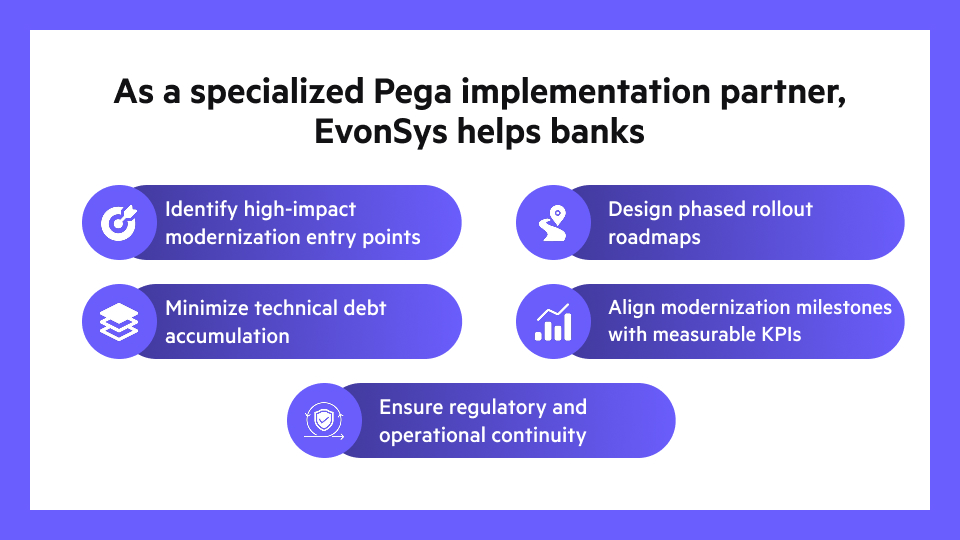
By aligning Constellation’s architecture with banking-specific transformation goals, EvonSys enables institutions to modernize confidently, without exposing core operations to unnecessary risk.

.png)


.png)