.png)

.png)
Banking operations have entered a new phase of structural complexity. With digital payment volumes surging, especially after COVID-19, banking operations are under operational strain. Banks began investing in scaling their infrastructure to manage operations incrementally, such as hiring more staff and layering new tools into the legacy system. These efforts rarely result in true scaling and improved performance. Instead, this way of scaling results in:
Every customer service request now triggers a chain of interdependent actions spanning multiple platforms and teams. Most banking architectures were never designed to orchestrate work across systems. Instead, they rely on siloed automation and manual intervention to bridge gaps. At the same time, customers demand instant resolution, real-time transaction updates, and seamless service across every channel.
This is where an orchestration layer, like Pega Agentic Process Fabric, helps in connecting the required AI agents and systems to deliver consistent outcomes. It creates a unified coordination layer across enterprise systems, enabling banks to scale operational complexity without proportionally scaling human intervention.
This is where Pega agentic AI for banking fundamentally changes the equation, enabling systems to reason, coordinate, and act autonomously across complex banking operations.
So, the core shift should be controlled scaling along with the banking workflow automation.
The discussion now centers around several key issues:
This is where Pega Infinity solves the problem. This blog explores how Pega Infinity ’25 enables banks to scale operations efficiently while meeting compliance requirements, improving customer experience, and maintaining cost discipline.
Pega Infinity ’25 approaches scalability differently. Instead of automating isolated tasks, it orchestrates the entire case lifecycle by embedding compliance, decisioning, and real-time visibility into a unified operational framework.
Automation alone does not create scalable operations. Pega Infinity ’25 for scaling banking operations introduces agentic workflows that embed AI agents directly into processes. These agents can:
Here’s how Pega Infinity for banking translates into controlled scaling:
Pega Infinity offers an Agentic process fabric that serves as a distributed orchestration layer, connecting workflows across systems without forcing consolidation or duplication. The 24/7 self-service agent from Pega helps scale banking operations by handling any request.
It’s about coordinating:
so that operations no longer live in a single system, lacking visibility and real-time updates.
One of the most significant operational challenges banks face is incomplete transparency. Employees often need to access multiple systems to understand the status of a single request or solve customer queries. Agentic Process Fabric resolves this by providing a unified operational view that consolidates context from across systems.
For employees, this removes the need to manually gather information across systems.
For customers, it ensures faster resolution, fewer handoffs, and consistent communication.
The experience shifts from reactive problem handling to coordinated, intelligent resolution.
To understand the operational impact of Agentic Process Fabric, let’s take a look at how a transaction cancellation request progresses from initiation to resolution within a bank using Pega Infinity.
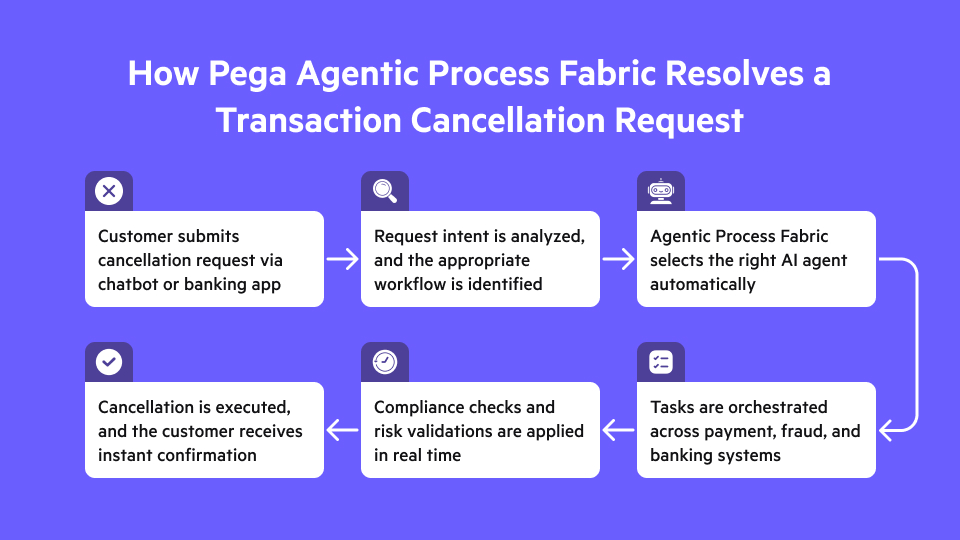
A customer plans to cancel a transaction that is no longer needed or was sent with incorrect details. The request is initiated through mobile banking, online banking, or a customer service representative.
Pega Infinity solves the query by introducing agentic AI for banking through Agentic Process Fabric. The Agentic Process Fabric immediately creates a unified operational case that tracks the request across systems.
The Agentic Fabric eliminates the manual effort of retrieving data from multiple systems and ensures decisions are based on real-time, complete context. With a single-screen workflow, data is pulled from different operating systems, thereby reducing the number of steps.
Embedded AI agents evaluate whether the transaction can be cancelled, reversed, or requires escalation.
Based on enterprise policies and real-time conditions, the system determines:
This decision-making occurs instantly, without requiring manual triaging. In this way, Pega helps in scaling banking operations without additional costs or hiring staff.
Agentic Process Fabric then coordinates execution by routing tasks to the required employees:
The Pega agentic AI continuously monitors the banking process with no manual intervention.
Throughout the process, Agentic Process Fabric maintains real-time visibility into resolution status. Once the cancellation or reversal process is completed, Agentic Process Fabric ensures all systems are updated consistently.
In banking operations, tasks vary by product type, risk category, and priority level. Agentic Process Fabric analyzes context and automatically routes tasks to the most appropriate AI agent. Pega agentic AI for banking enables skill-based routing, thereby reducing manual triaging and shortening the resolution cycle.
Without Agentic Process Fabric, resolving a transaction cancellation requires human coordination across multiple systems and teams, introducing delays, operational overhead, and inconsistent customer experiences.
With Agentic Process Fabric, orchestration becomes autonomous and continuous. Systems, AI agents, and employees operate within a unified coordination layer, enabling banks to resolve requests faster, reduce operational friction, and deliver a more responsive and reliable customer experience.
Successfully implementing Pega for scaling bank operations requires more than configuration. It demands:
From strategy and architecture design to implementation and optimization, Evonsys ensures that:
Pega agentic AI executes tasks autonomously while following defined business rules and compliance policies. Unlike standalone bots, Pega agentic AI for banking operates within governed processes, ensuring decisions remain auditable, explainable, and aligned with regulatory standards.
Pega Agentic Process Fabric is an orchestration layer that connects AI agents, workflows, employees, systems, and data into a unified, governed execution framework. It ensures that driven tasks are coordinated, context-aware, compliant, and fully auditable across the organization.
Yes, Pega’s architecture is designed to orchestrate work across existing core systems, CRM platforms, payment engines, and third-party applications without requiring full system replacement.
Ready to modernize and scale with control?
Let’s build your next-gen banking operations

.png)


.png)