.png)

.png)
Digital payments are growing very quickly. From domestic to cross-border transactions, customers now expect every payment to be seamless. But when something is delayed, expectations shift even higher. Customers want immediate clarity, faster resolution, and complete transparency.
For banks, the rise in digital payments has increased the complexity of disputes. A typical bank dispute today may involve multiple systems, regulatory checkpoints, payment networks, and internal teams. Investigators need to switch between core banking systems, card platforms, CRM tools, email threads, and spreadsheets just to gather basic information. This may seem manageable when dispute volume is low, but it results in longer resolution cycles, frustrated customers, and higher costs per dispute as volume increases.
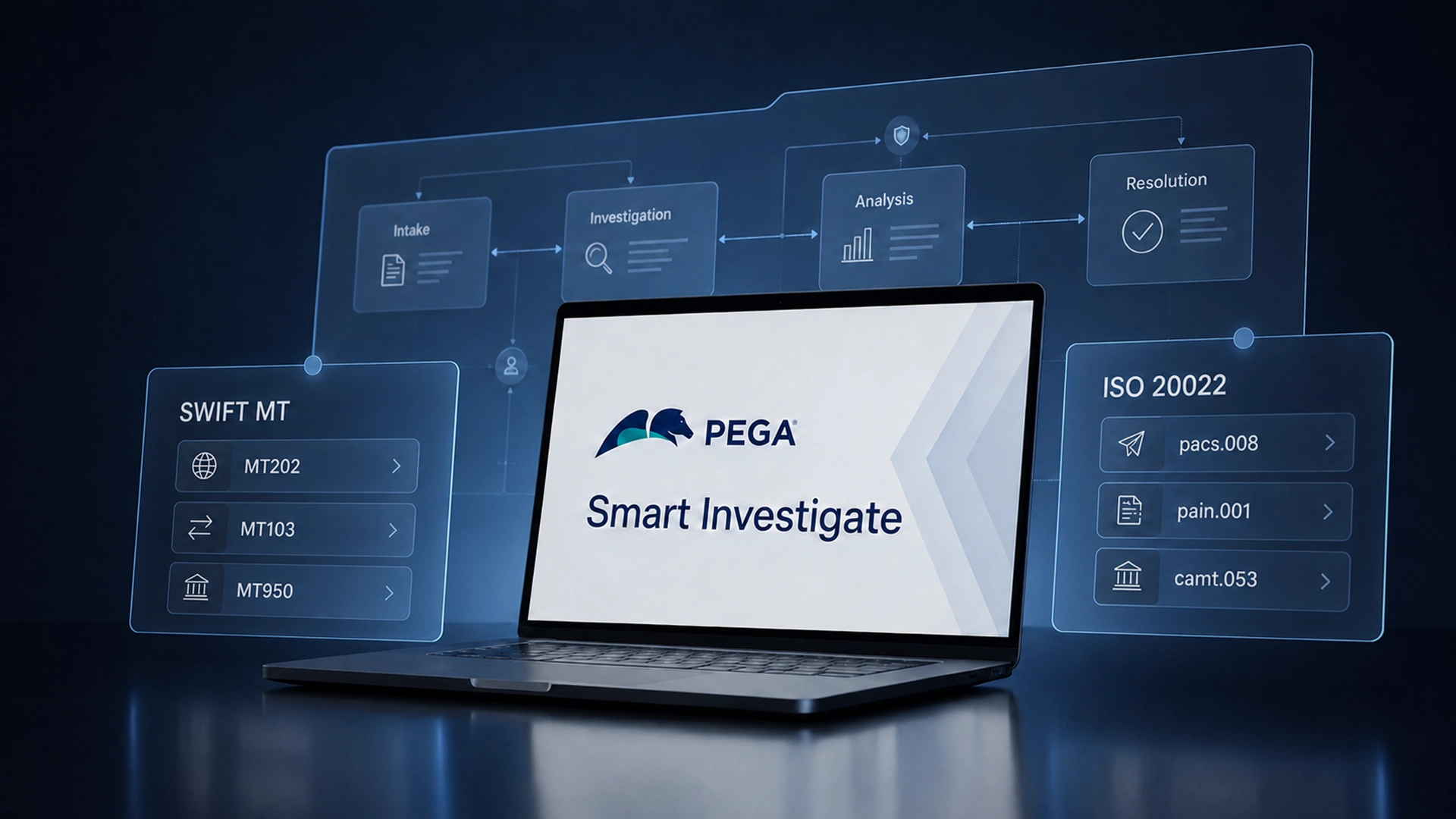
This is where Pega Smart Dispute Agentic Automation enables banks to redesign how they manage disputes from intake to resolution. Instead of relying on disconnected tools, Pega dispute management centralizes every dispute into a structured, trackable case.
Pega Smart Dispute Agentic Automation is a comprehensive, AI-powered software solution for financial institutions to manage the entire lifecycle of payment disputes. The solution acts as a central hub that connects disparate systems, channels, and payment networks.
Payment disputes happen when a cardholder questions a transaction with their bank. Common types of disputes include fraudulent transactions, non-receipt of goods/services, duplicate charges, incorrect billing amounts, and subscription cancellations that were still deducted.
When the team handles disputes manually in a disconnected system, they face challenges such as delays and increased costs, as explained below.
When banks face disputes, the management is not a single workflow. It is a chain of disconnected activities spread across systems that requires:
None of these systems was initially built to function as a unified dispute orchestration engine, leading to:
Pega Smart Dispute Agentic Automation is built on Pega Customer Service for Financial Services (CSFS), which leverages the Financial Services Common Data Model (CDM-FS) and the Pega Platform.
The Pega CSFS helps in bank disputes by unifying interaction management across channels. Instead of operating multiple disconnected tools for case tracking, chargebacks, customer interactions, and reporting, banks can centralize dispute workflows on a unified case management layer with standardized data definitions.
This structured approach defines clear relationships among the customer, their transaction, and the dispute case, creating a connected, streamlined process.
Traditional dispute handling heavily depends on manual task assignment and follow-ups. Cases are forwarded through email, escalations rely on individual oversight, and SLA tracking is often reactive. This manual structure creates bottlenecks:
Over time, this increases the average resolution cycle, directly affecting customer satisfaction.
Pega Smart Dispute Agentic Automation addresses these inefficiencies by centralizing and automating the end-to-end dispute lifecycle.
The multi-channel dispute case intake allows customers to raise disputes through call center, web, chat, email, or digital messaging channels, while routing all cases into a single, standardized workflow.
The straight-through processing (STP) automates routine claims and chargeback submissions. Instead of manually reviewing and forwarding cases to card networks, eligible disputes are processed automatically and submitted in near real time.
Underpinning these capabilities is the Pega Platform, which delivers AI-powered decisioning and workflow automation.

By replacing spreadsheet-driven tracking, manual validations, and fragmented handoffs with intelligent automation, Pega Smart Dispute transforms slow, error-prone processes into streamlined, compliant, and scalable operations.
Successful modernization requires domain expertise and an orchestration-first architecture that aligns with the phased execution. As a trusted Pega implementation partner, EvonSys helps financial institutions redesign dispute operations with automation and minimal disruption.
Let’s build a dispute management solution designed for digital scale.
Partner with EvonSys to transform your dispute lifecycle with Pega Smart Dispute Agentic Automation.

.png)


.png)