.png)

.png)
Managing volunteers often starts simple, but quickly turns into a cycle of last-minute changes, missed updates, and constant follow-ups. Coordinators spend more time fixing schedules than actually focusing on their programs.
This is where the scheduling software makes a difference. It helps nonprofits organize shifts, streamline communication, and bring better visibility into volunteer participation.
In this blog, you’ll learn why traditional approaches fall short, how scheduling needs evolve as your programs grow, and what to look for in a system that supports smarter, more reliable volunteer management.
For many nonprofits, volunteer scheduling may seem like a simple task that can be handled with a few manual steps. On the surface, it seems manageable, as it’s about assigning people to shifts that match their skills and interests. But this is where the real disconnect begins.
A coordinator spends hours each week chasing confirmations across communication channels that never reflect the latest update. Every change, whether it’s a volunteer dropping out or switching shifts, must be manually tracked and communicated again.
In this way, half the time is wasted, and there’s no single, reliable view of who is showing up.
As a result:
The real challenge is the lack of a dependable system that keeps volunteer availability, communication, and shift assignments in sync.
This is where nonprofits understand the importance of dedicated software for volunteer management. The best volunteer scheduling software doesn’t stop at automating communication and management. The software streamlines operations through mobile-friendly, self-service portals, automated communication, and real-time tracking.
Now that nonprofits look for scheduling software, the goal is to find a tool that can quickly and efficiently assign volunteers to shifts. And on the surface, most tools do exactly that.
Most free volunteer scheduling software is built to solve scheduling problems, but it doesn’t integrate with the rest of nonprofit's operations. This can create data silos, where volunteer and donor information remain separate, leading to duplicate entries and manual data-entry errors.
The best volunteer scheduling software goes beyond shift assignment. It brings together scheduling with volunteer data, engagement history, and real-time visibility.
Without any upfront cost, this software helps nonprofits with:
But the challenge arises when coordinators seek a reporting tool to analyze, track, and visualize volunteer activity. Without it, tracking volunteer contributions is difficult.
As volunteer bases grow and programs become more dynamic, what once felt simple starts becoming restrictive:
Often, free scheduling software omits volunteer history, preferences, and engagement patterns, making decision-making difficult. As a result, teams often compensate by using spreadsheets, messages, and manual follow-ups, only to bring back the very inefficiencies they were trying to eliminate.
This is where many nonprofits start re-evaluating their approach to finding the best volunteer scheduling software.
Once nonprofits understand that traditional or free volunteer scheduling software isn’t enough, the next step is to rethink how scheduling works. The real shift is from managing volunteers to understanding participation.
In a typical setup, scheduling decisions are made in isolation:
Many teams try to stretch the free volunteer scheduling software to support this level of planning. But these tools are built for simplicity, not depth. They don’t retain enough context to support smarter decisions over time.
To enable this shift, scheduling needs to be part of a larger system rather than a separate function. This is where the volunteer management built on Salesforce stands out. By bringing scheduling into a unified environment with volunteer data and engagement history, they give nonprofits the context they’ve been missing.
For instance:
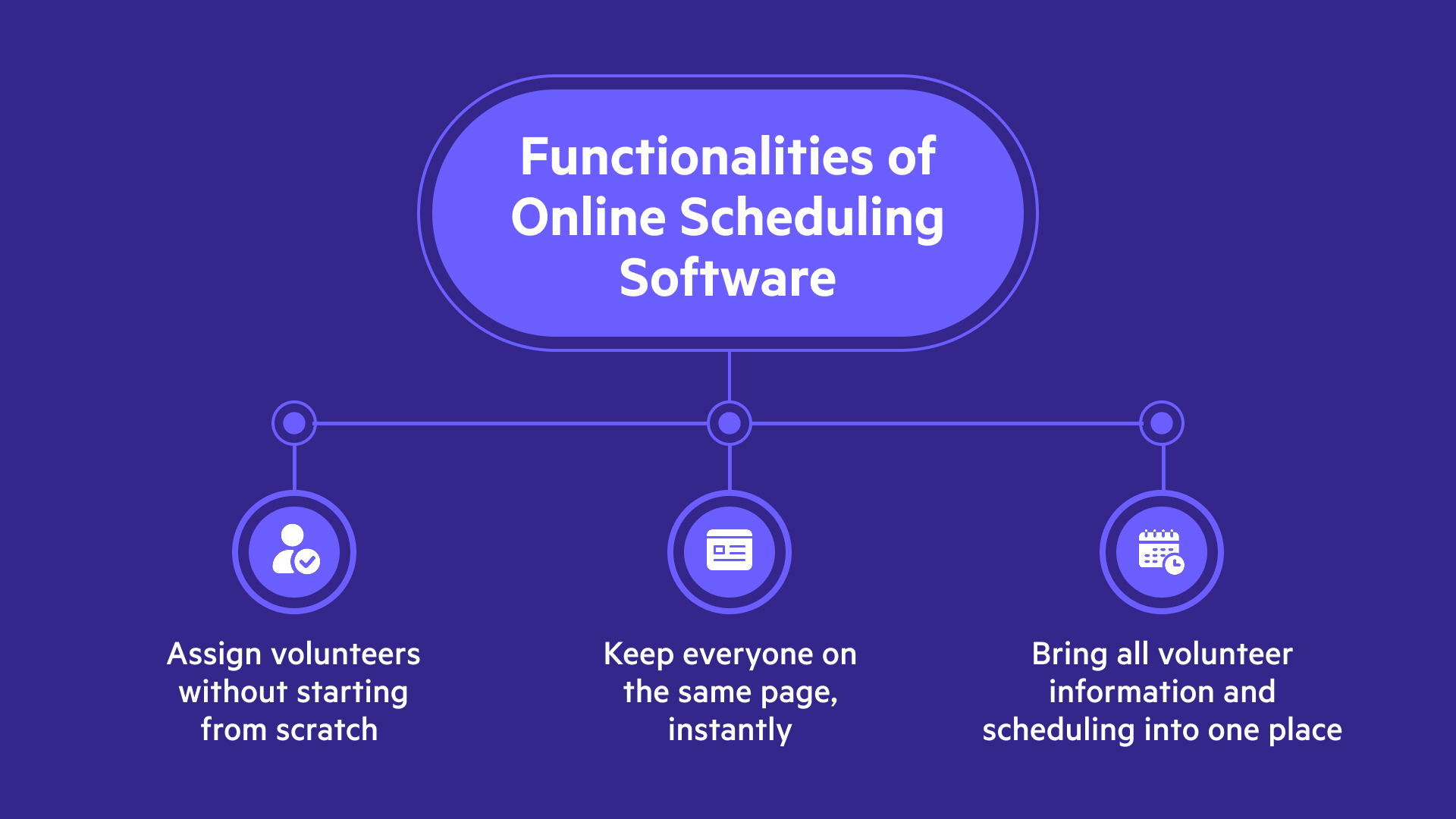
Assign volunteers without starting from scratch
Scheduling is not limited to availability. The system considers volunteer history, participation patterns, and reliability while assigning roles. Instead of repeatedly checking the availability, coordinators work with a system that already knows who shows up, who cancels, and who fits best.
Keep everyone on the same page, instantly
Every update, such as a shift change, cancellation, or reassignment, is instantly reflected across all communication channels. So, coordinators no longer have to chase confirmations across tools that do not reflect the latest updates.
Bring all volunteer information and scheduling into one place
Scheduling is built on top of a centralized volunteer database that includes engagement history, preferences, and past activity. This directly solves the problem of data silos in free scheduling software by bringing scheduling and volunteer insights into a single system.
When scheduling software is part of the CRM, volunteer coordination becomes connected, consistent, and easier to manage at every level.
Instead of switching between tools, everything works together in one place. Volunteer details, availability, communications, and participation history are all accessible within a single system, giving coordinators the clarity they need to make decisions.
This connected approach changes how scheduling feels in day-to-day operations.
Every assignment is informed
Coordinators can view volunteer history, preferences, and past participation while scheduling, making it easier to match the right people to the right roles.
Coordination becomes seamless across teams
With shared access to the same data, teams can plan and manage schedules without duplication or confusion.
Real-time visibility improves planning
Updates, availability, and changes are reflected instantly, helping teams stay aligned without constant follow-ups.
Reporting becomes effortless
Since participation data is captured within the same system, generating insights for stakeholders or funding needs is faster and more accurate.
This is where volunteer management built on Salesforce brings real value. By embedding scheduling directly into a CRM environment, nonprofits gain a unified view of their volunteer ecosystem.
Once scheduling is connected to the broader system, the way nonprofits operate begins to change.
What was once a series of manual coordination efforts becomes a more structured, intelligent process, where decisions are informed by real data rather than assumptions.
This is where EvonSys shifts the approach from coordination to orchestration.
Instead of simply helping teams assign volunteers to shifts, it enables nonprofits to manage the full picture:
Built on Salesforce, our volunteer management system brings all of this into a single, scalable system. As a result, nonprofits move away from constant follow-ups and operate in a more predictable and manageable way.
Discover how connected scheduling software can transform the way your volunteer management works

.png)


.png)