.png)

.png)
Every nonprofit organization aims to create meaningful impact and run successful programs. For a small team of two or three people, making that happen is no small feat. Their efforts begin to get noticed, word spreads, and community interest starts to grow. When a new campaign is launched, more people step forward, ready to contribute their time and energy.
At first, this feels like a clear win. But for a small team, growing volunteer interest can quickly become difficult to manage. Without the right systems in place, increased support brings added complexity.
Volunteers represent more than just helping hands. The estimated value of a volunteer hour is around $35, making their contribution a significant asset for any nonprofit. When that time is not tracked or managed effectively, the organization risks losing both insight and impact.
In the early stages, managing volunteers through spreadsheets and shared inboxes can work. As the number grows into the hundreds, this approach begins to break down. Spreadsheets become harder to maintain, inboxes fill up faster than they can be managed, and the personal connection with volunteers starts to fade.
At this stage, growth no longer feels simple. The challenge is not with the mission or the willingness of volunteers, but with the systems being used to manage them.
This is why investing in the right volunteer management software becomes a critical step. It allows nonprofits to scale their efforts without losing clarity, structure, or connection.
Manual Tracking Breaks Down Fast
Many nonprofits begin their volunteer journey by using spreadsheets. They use them to track volunteer registration, contact details, availability, hours served, and skill sets. This works for a small group. However, it becomes unreliable when teams try to manage volunteers in large numbers.
Data errors and duplicates make records inaccurate. Without centralized volunteer management software, teams spend more time fixing data issues than supporting their mission.
Scheduling Becomes Reactive, Not Strategic
Larger volunteer management programs involve multiple events running at the same time. Each one has different shift times, skill needs, and headcounts.
Without proper tools, scheduling manually leads to last-minute cancellations, resulting in unfilled shifts and constant back-and-forth communication. For large teams, this reactive coordination wastes time that could be better spent on strategically managing volunteers.
Communication Falls Apart
As volunteer numbers increase, messages become scattered across email threads, texts, and apps. Important updates get buried, causing volunteers to show up at the wrong location or on the wrong day. Staff inboxes flood with repeated questions.
This breakdown hurts the quality of your volunteer management programs and damages trust. Volunteers who feel disorganised rarely come back.
Staff Burnout
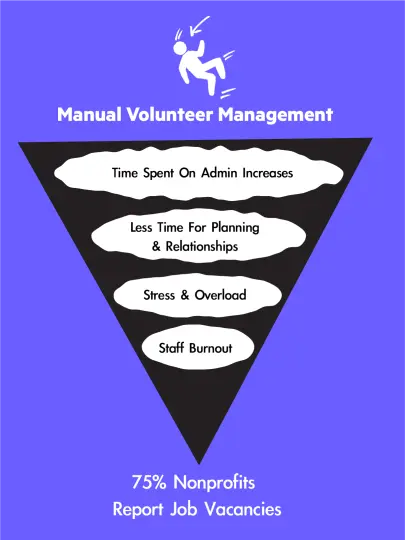
When small teams are forced to manage volunteers manually, staff burnout becomes inevitable. Coordinators spend more time on admin work, spending less time on planning and relationship-building.
As time has passed, this pressure has led to a crisis, with nearly 75% of nonprofits reporting job vacancies. Administrative overload is one of the main reasons staff members leave. Additionally, the presence of inefficient systems not only hinders productivity but also drives capable volunteers away.
Volunteer Disengagement
Volunteers want clear instructions and recognition for their time. When your volunteer management programs run on broken tools, instructions arrive late. Volunteer contributions go unacknowledged. Even your most committed supporters start to pull back. Disengaged volunteers do not just stop showing up. They stop recommending your organization to others.
Hiring more administrative staff is not affordable for most small nonprofits. Even when possible, adding people to broken processes increases complexity.
The real answer is volunteer management software that scales with your programs. The right tool lets a small team manage volunteers across hundreds of shifts, multiple locations, and dozens of skill sets, without adding headcounts.
EvonSys Volunteer Management, built natively on Salesforce Lightning, is designed to eliminate the challenges of manual coordination. This tool removes the limitations of manual tools, and it helps small nonprofits run structured volunteer management programs. It does this without increasing the workload.
Centralized Volunteer Data Management
Every volunteer record is housed in a centralized system, ensuring that skills, availability, contribution hours, and documents are consistently up to date. This streamlined approach empowers coordinators to manage volunteers with confidence, eliminating the hassle of sifting through various files or spreadsheets.
Skill-Based Volunteer Matching
The platform effectively connects volunteers to programs that align with their skills and interests. Eliminating mismatches ensures that individuals are placed in roles where they can truly thrive.
This not only boosts the sense of fulfilment among volunteers but also allows coordinators to focus less on tedious role assignments, ultimately creating a more efficient and rewarding experience for everyone involved.
Automated Scheduling and Notifications
Automated scheduling eliminates endless email chains, ensuring that volunteers receive timely updates and reminders. Last-minute communication is reduced, and no-show rates drop. Programs can run on schedule without constant follow-up from your team, leading to smoother execution.
Real-Time Tracking and Reporting
The platform automatically tracks volunteer hours, shift attendance, and program impact. Built-in dashboards clearly display your data. You can generate grant reports, meet compliance requirements, and demonstrate the value of your volunteer management programs, all without manual data entry.
Large volunteer management programs should represent growth and opportunity. They should not cause stress. For small nonprofit teams, the challenge is not enthusiasm. The challenge is outdated systems.
Nonprofits must replace spreadsheets with volunteer management software. This helps you move from reactive coordination to proactive planning.
Invest in modern tools like Volunteer Management Lightning. With this, Volunteers stay engaged, and staff stay focused. Your impact grows without your workload doubling.

.png)


.png)